Hull Rupture is not a linear march to a final boss. The Hull Rupture galaxy map is a web of opportunities, and the ship can only reach a fraction of them. Choosing where to fly is how you compensate for a bad shop, chase a specific modifier, or decide that the safer route is worth more than the shinier one.
Why routes decide runs
Between waves, the map gives you short-term goals. Not every destination is equally valuable, and the value changes with the state of your ship. A fuel-rich build can afford a long detour for a rare artifact. A mineral-starved build may need the next market more than another random event. A defense-light build should avoid guarded stars entirely.
The developer’s design goal is to make you look at a star and think: “I know what might be waiting there, and the potential profit is worth the risk.” That is a skill you build by playing, not a fixed route you memorize. The map generation follows patterns, but it does not repeat the same layout every run.
How the map works
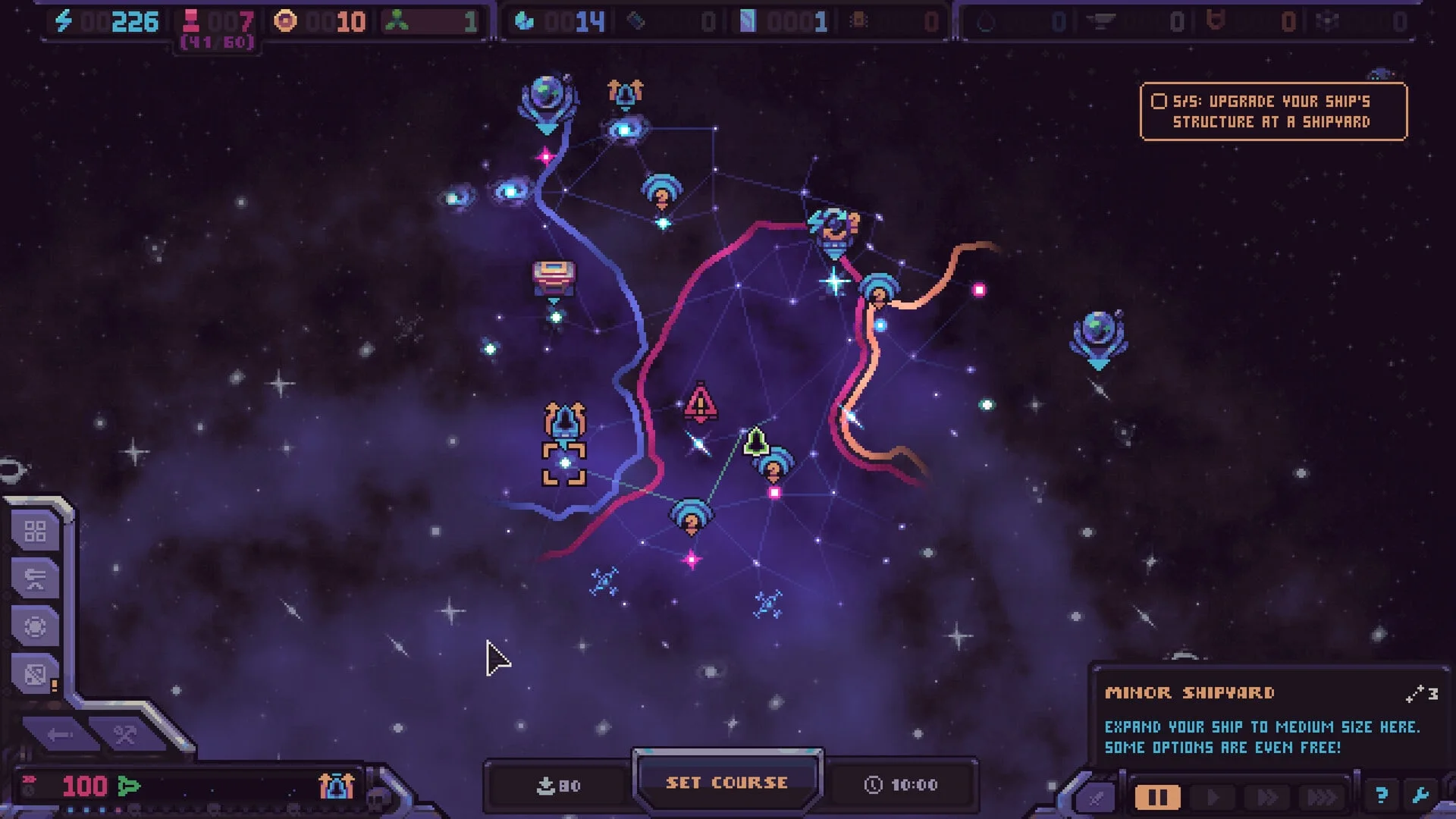
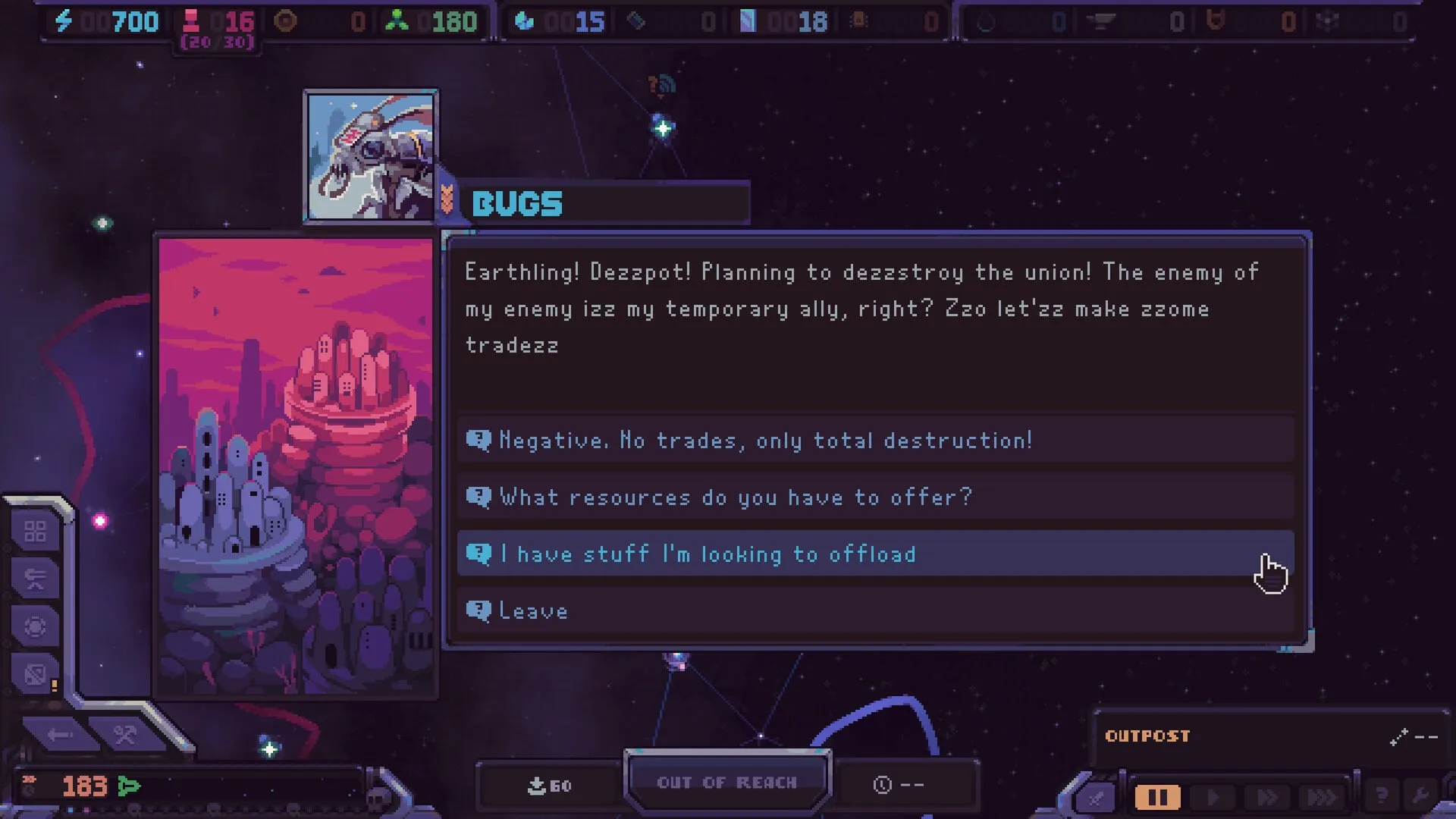
Parts of the map begin hidden behind fog of war. As you explore, you reveal the types of stars around you, but not necessarily the exact event waiting at each one. Random-event stars are the most common example: you know an event is there, not which one. A black market tells you that turrets are for sale, and experience teaches you which turrets can appear.
The map has around 15 star types, each with different opportunities and bonuses. You cannot visit all of them in one run. The practical question is not “which star is best?” but “which star solves the constraint my ship has right now?”
Star types and what they offer
The developer has documented several destination categories. Exact icons and names are learned in-game; these are the strategic archetypes.
Random events
Narrative choices that can grant modifiers, resources or problems. The most common source of build-changing upgrades.
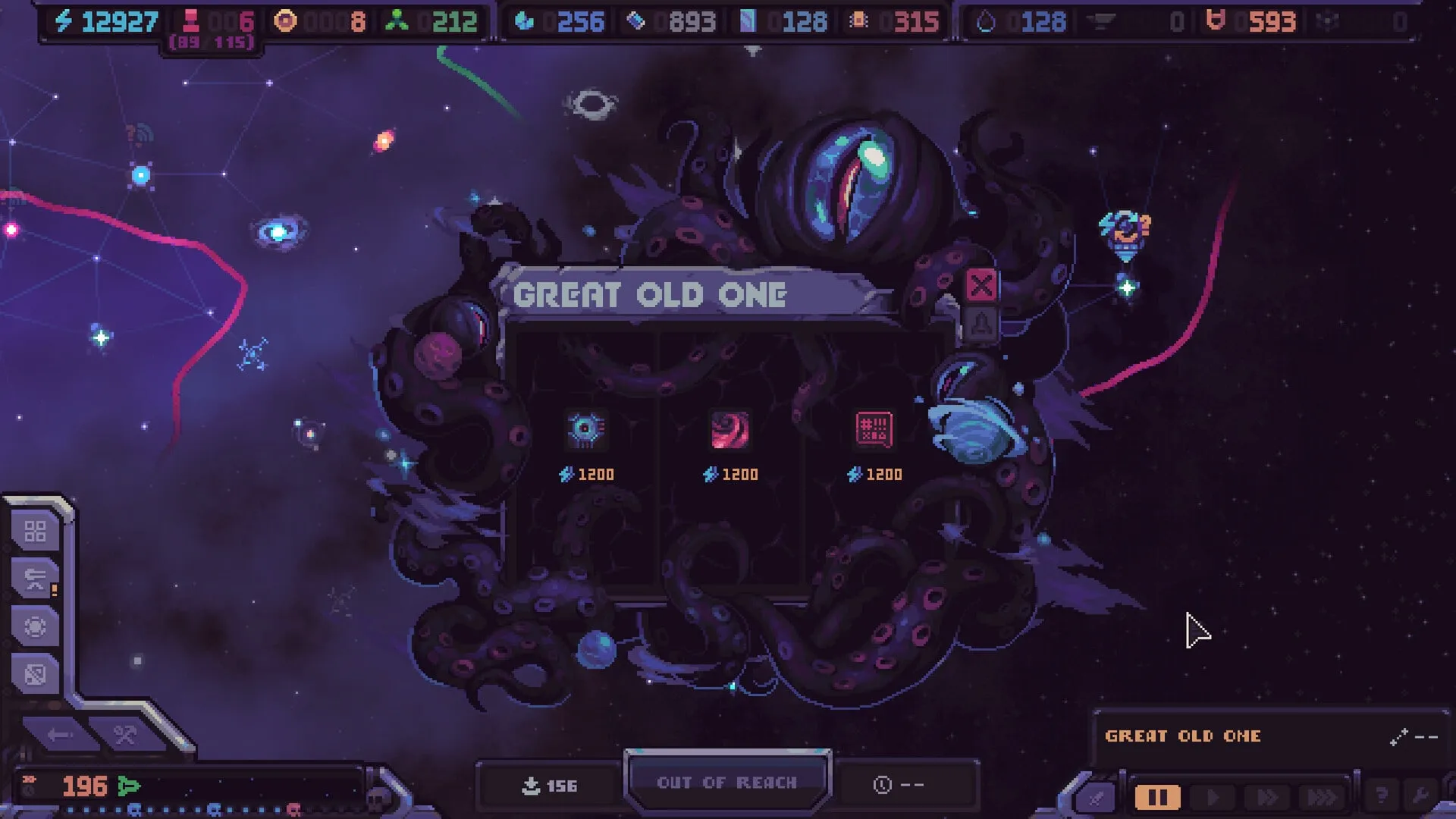
Shops
Spend tokens on modules, turrets and supplies. Shop modifiers come from a largely separate pool from event modifiers.
Black markets
A known opportunity to buy turrets. Experience teaches which turrets can appear and which never will.
Shipyards
Ship structure development and layout control. Some options are free; others cost resources.
Guarded locations
Higher-difficulty destinations that trigger extra waves not counted toward the 20-wave run. High risk, high reward.
Resource caches
Direct infusions of fuel, minerals or advanced materials. Useful when the economy is input-starved rather than rate-starved.
The exact names and frequencies are not fully documented. Treat this as a decision framework, not a star atlas. The in-game tooltip is the authority.
Engines, mass and fuel: the route tax
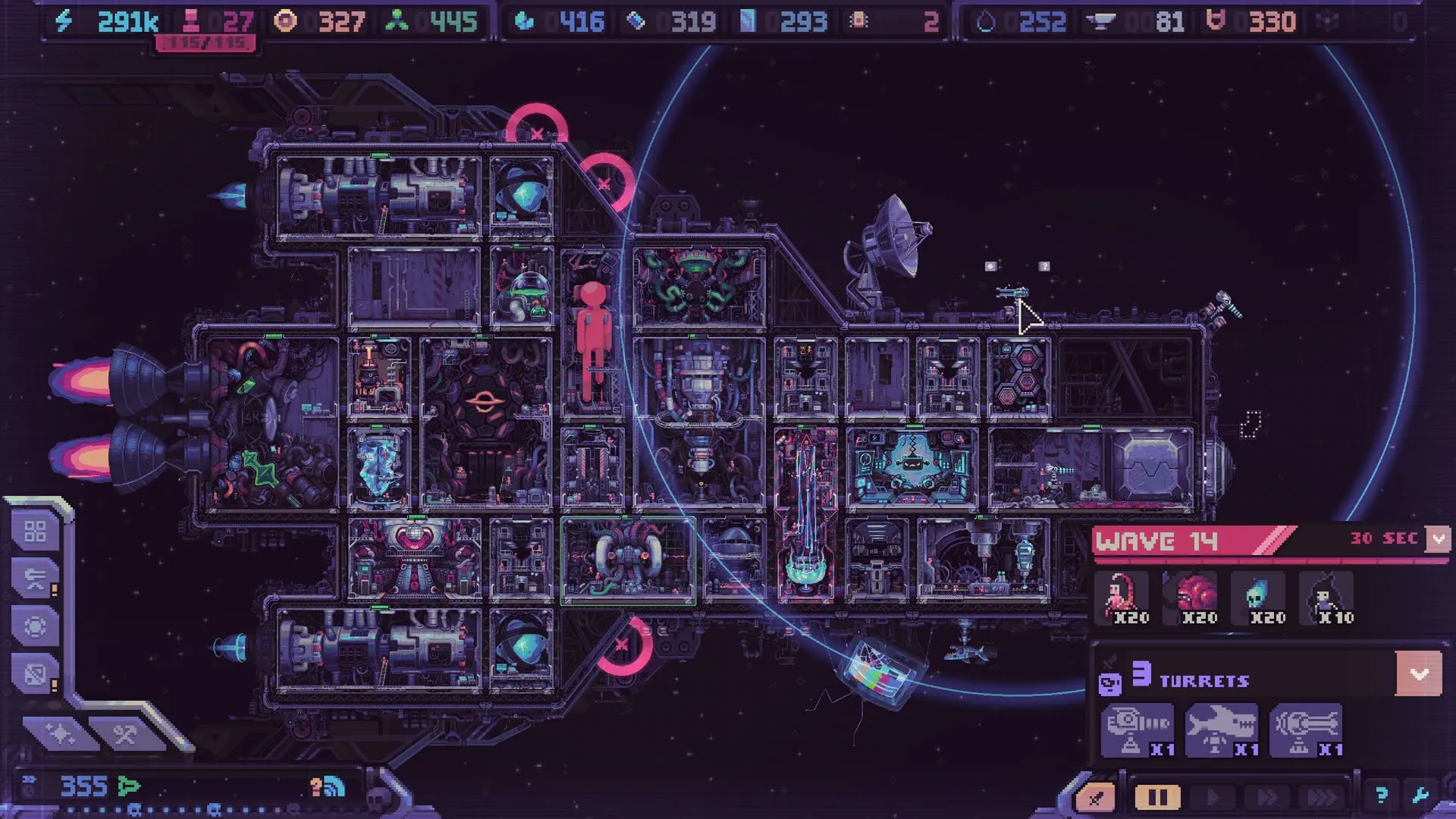
Travel speed depends on two things: the number and level of your engines, and the total mass of the ship. Expansion makes the ship heavier. Heavier ships travel slower unless you add engine power. Engines and additional engine units burn fuel. There is no free speed.
This creates two viable route philosophies:
- Low-mass sprint. Keep the ship lean, invest minimally in engines and visit more destinations. You spend less fuel and fewer resources on propulsion, but you have less production capacity and fewer defensive slots.
- Heavy industrial crawl. Build a large factory and enough engines to drag it across the map. You reach fewer stars, but each stop can be exploited with a stronger economy and a deeper defense.
The Izumo is described as a small, maneuverable ship, and one of the three starting ships is explicitly built around a low-mass, high-speed playstyle. If you are playing that hull, detours are cheaper; if you are playing a heavy hull, every jump needs to be worth more.
A full fuel bar is not a route plan
Fuel keeps the engine running; it does not guarantee you can reach every star before the next wave. Check travel time against your wave timer. A profitable detour that arrives after the wave has already started is not profit.
Hull Rupture events and modifiers: build instructions in disguise
Modifiers are upgrades installed in individual ship modules. They can come from shops or narrative events, and the two sources draw from largely different pools. Some shop modifiers never appear in events; most event modifiers cannot be bought. That means route choice determines which upgrades you can even be offered.
A single modifier can change the rest of the run. The developer’s example: mushrooms added to the Mineral Generator significantly increase Mineral output, but only while you have fewer than 10 units of Mystic Goo. Receiving it may convince you to abandon Goo production entirely and restructure the economy around mining.
Other modifiers affect combat. Reproducer Eyes allows Beam turrets to apply Fragility. A modifier that looks like an economy upgrade can therefore become a defense multiplier. Before you dismiss an event reward, check which module it attaches to and what that module already does.
Events are conditional
Events are not selected entirely at random. The state of your ship can determine whether an event appears, and individual choices can have their own requirements. If an event offers to sacrifice 20 humans but your workforce is below that number, the option is unavailable. This is another reason to keep a buffer of people: not every opportunity is purchasable with tokens.
Risk: guarded systems and the cost of curiosity
Guarded locations are planned for the full release and are intended for higher difficulty levels. Arriving triggers additional enemy waves that do not count toward the normal 20 waves. The reward is real, but so is the strain on your economy: extra waves consume turret uptime, human lives and repair resources.
A guarded star is worth visiting when your defense is overbuilt for the current wave and your economy can absorb a delay. It is not worth visiting when you are already leaking, low on fuel or saving for a critical shop purchase. The map is generous with opportunities; the run is not generous with second chances.
A route decision framework
- Name the constraint. Is the ship short on defense, fuel, a specific resource, or upgrade options?
- Match the star to the constraint. Defense → black market or guarded reward. Economy → resource cache or shop. Build flexibility → event or shipyard.
- Price the detour. Check travel time, fuel cost and wave timer. A route that arrives late is a different route.
- Check the hull cost. If the destination requires more modules to exploit, remember the mass and power bill.
- Commit or skip. Half-measures waste fuel. If the stop is not worth the detour, take the safer line and bank the savings.
Route-planning mistakes
1. Visiting every shiny star
The map is designed so you cannot see everything. Trying to do so burns fuel and time and leaves you underdefended for the wave you delayed.
2. Ignoring the modifier pool
If your build needs a shop-only modifier, an event-heavy route will not provide it. Route choice is upgrade choice.
3. Overbuilding engines to fix mass
Engines add speed but also fuel demand. Sometimes the correct fix is to stop expanding, not to add another engine.
4. Treating guarded stars as free loot
Extra waves do not count toward the 20, but they still kill crew and consume resources. Go in with a defense that is already winning, not one that is hoping to.
5. Arriving at a shop with no tokens
A shop you cannot use is a wasted stop. If tokens are the constraint, route toward income or events, not a market.
Hull Rupture galaxy map FAQ
Quick answers
Exploration questions
How many star types are in Hull Rupture?
The developer states there are around 15 types of stars, each offering different opportunities and bonuses. It is impossible to visit all of them in a single run, so route planning is about choosing which opportunities your build needs.
What are guarded locations in Hull Rupture?
Guarded locations are planned for the full release at higher difficulty levels. Arriving at one triggers additional enemy waves that do not count toward the normal 20-wave run. The reward comes with extra danger and strain on the economy.
Do shop and event modifiers share a pool?
Largely not. The developer says the two sources draw from largely different pools: some shop modifiers never appear in events, and most event modifiers cannot be purchased. That makes route choice a decision about which upgrades you can even be offered.
How does travel speed work in Hull Rupture?
Travel speed depends on the number and level of engines, minus the total mass of the ship. More modules make the ship heavier and slower. Engines and extra engine units consume fuel, so speed has an ongoing economic cost.
What do shipyards do in Hull Rupture?
Shipyards offer ship structure upgrades and some control over the layout and construction slots available. The September demo moved most expansion into Hull Construction during flight, while shipyards remain a map destination for ship development.
Are wormholes in Hull Rupture?
Wormholes are planned for the full release. They are described as working similarly to teleporters in Heroes of Might and Magic, connecting distant parts of the galaxy. If you have not discovered the other end, you will not know where it leads.
Next step
Routes change the ship, and the ship changes the routes. Read the ships and modes guide to understand how hull identity shapes exploration, then the artifacts guide for the rewards worth chasing.