Hull Rupture is a base-management tower-defense roguelite from Konfa Games and tinyBuild. You command the Despot AI, keep a jury-rigged warship moving for 20 waves, and treat the human crew as both workforce and fuel. This wiki is an independent reference for the systems that decide whether the ship reaches the alien homeworld or becomes a very expensive debris field.
There is no official Hull Rupture wiki at the time of writing. This Hull Rupture wiki fills that gap with dated information from Steam, official developer posts and hands-on previews, then adds original strategy analysis. Where the developer has not published a number, we say so instead of inventing one.
What kind of game is Hull Rupture?
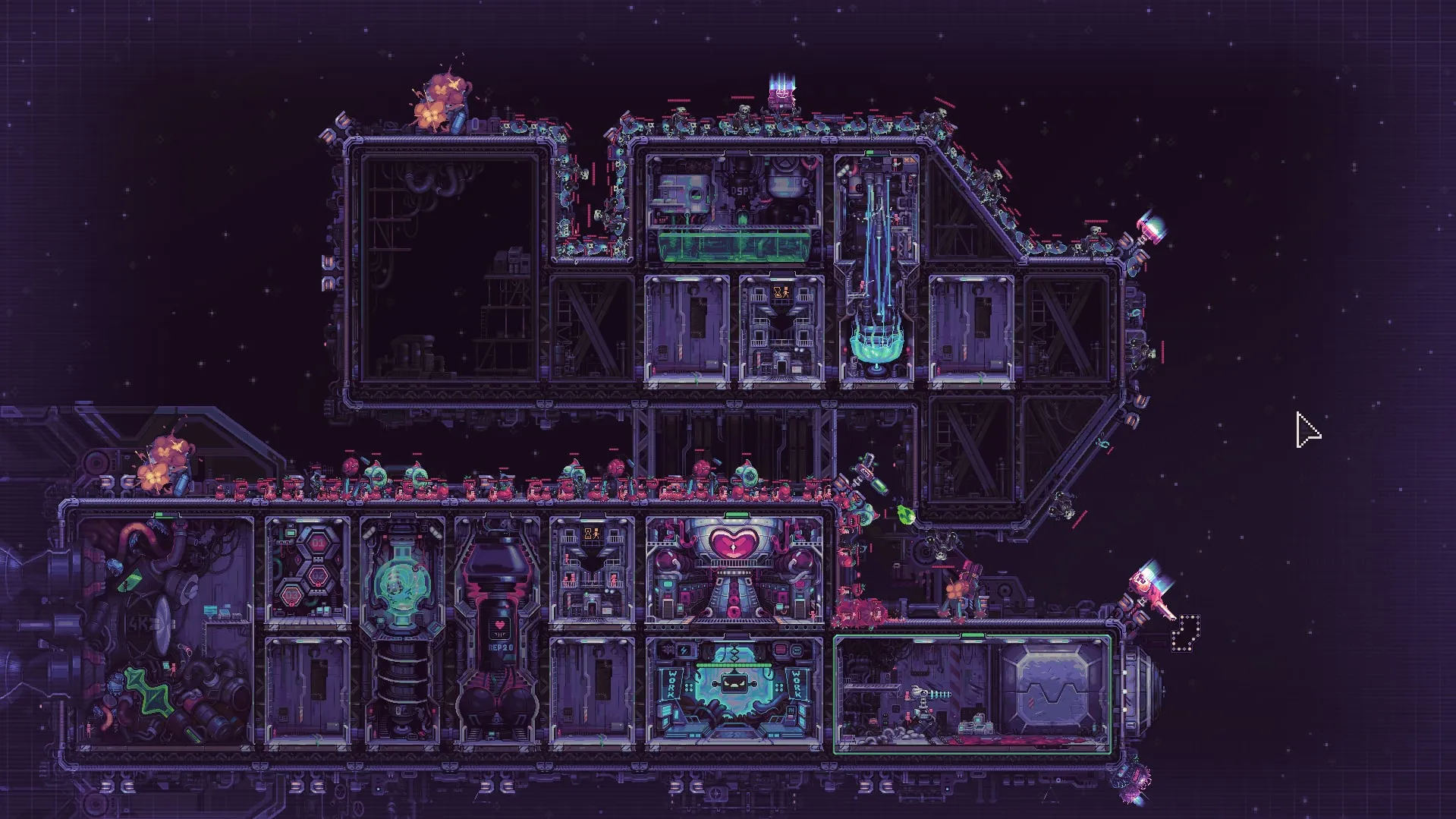
It is easiest to understand as three games running at once. The first is a colony sim: humans work modules, consume inputs and produce resources. The second is a tower defense game: alien drop pods land on the outer hull and run toward the Airlock while turrets fire from dedicated slots. The third is a roguelite route planner: a galaxy map offers events, shops, shipyards and risk, and you choose which consequences to accept.
The three systems share one budget. A new module consumes hull space, adds mass, draws power and needs workers. A new turret consumes construction resources that could have fixed a production chain. A detour to a profitable star costs fuel and time. The “best” choice is almost always the one that solves the next constraint without creating two more.
Run structure
20 waves + final boss
Combat pacing
Real time, economy never pauses
Failure state
Despot destroyed
The core loop, step by step
- Fly. The ship travels between stars. Travel speed depends on engine count and level versus total ship mass.
- Produce. Humans staff modules that generate energy, fuel, tokens, minerals and advanced resources.
- Expand. Enter Hull Construction to place a random hull block, opening new module slots and reshaping alien routes.
- Defend. When a wave lands, turrets and traps thin the boarding party before it reaches the Airlock.
- Spend. After the wave, buy a themed module or turret box, then use the kit to fill a useful slot.
- Choose a route. Events, shops, shipyards and guarded stars offer rewards at a cost. Pick what the build needs.
- Repeat until wave 20 and the final boss. Then the run ends — or Endless mode begins, depending on the mode.
The one-sentence strategy
Spend the minimum on defense that survives the next wave, put everything else into the economy, and never let the engine run dry. That is the whole game in one line — the difficulty is judging “minimum.”
Shipbuilding systems
Hull Construction
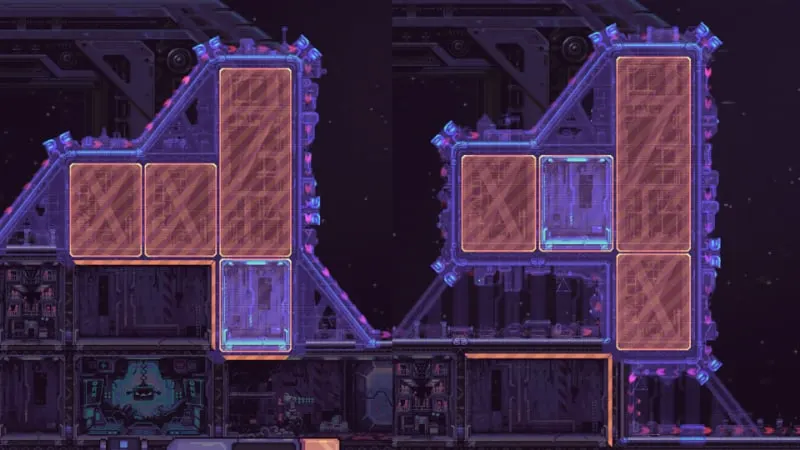
Hull Construction pauses flight and offers a random block with empty module slots. Blocks cannot be rotated or removed, cannot block the Airlock or Engine, and may be placed slightly away from the hull on “stilts” to create a corridor. Fifteen shapes exist and do not repeat until the set cycles. Placing a block costs Energy early and Plasteel later; skipping one also costs resources.
The key rule is adjacency: an empty module slot becomes buildable only when a completed module is next to it. That makes hull placement a production decision as much as a defensive one. Read the full Hull Construction guide for placement patterns.
Modules and adjacency
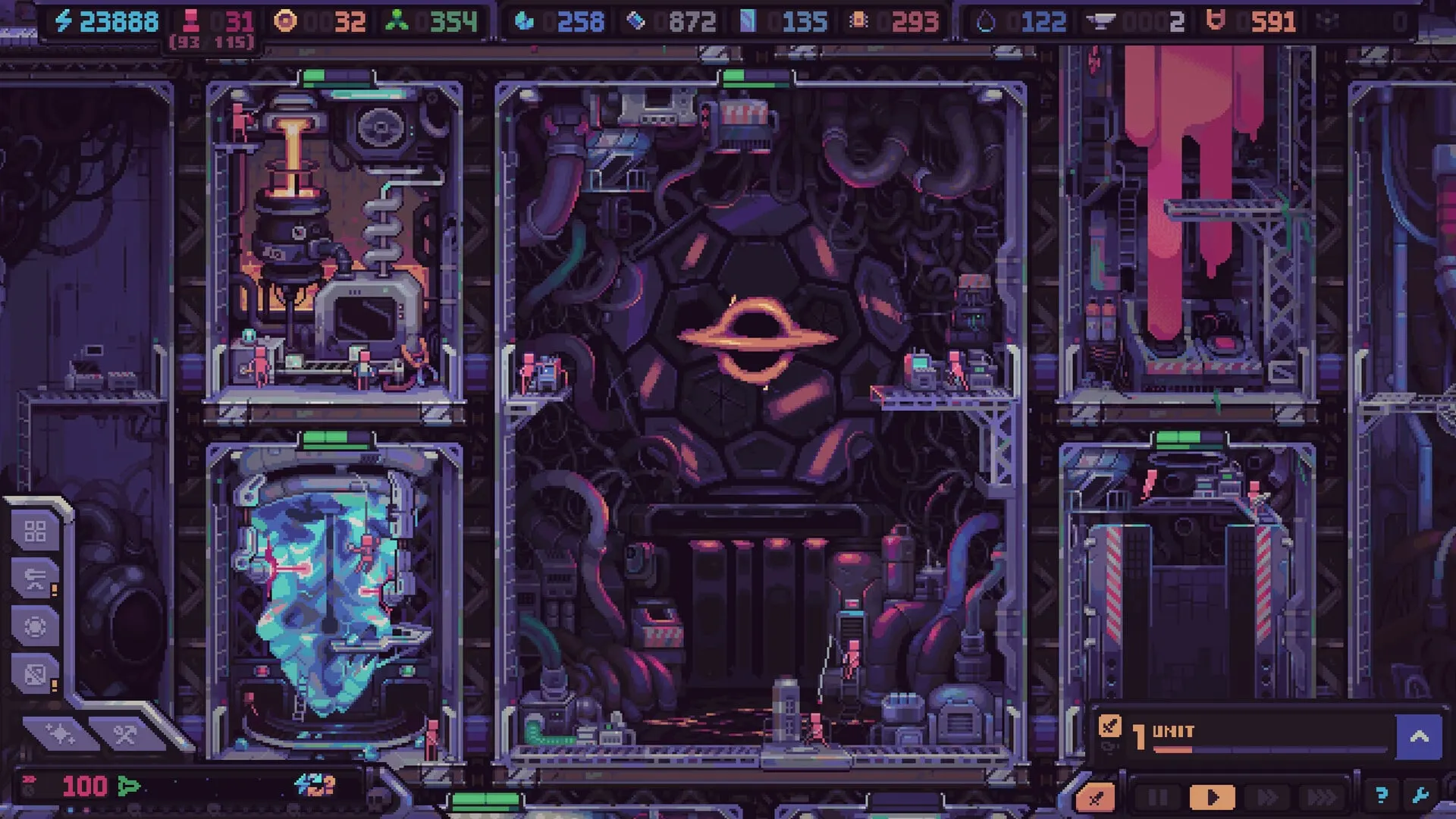
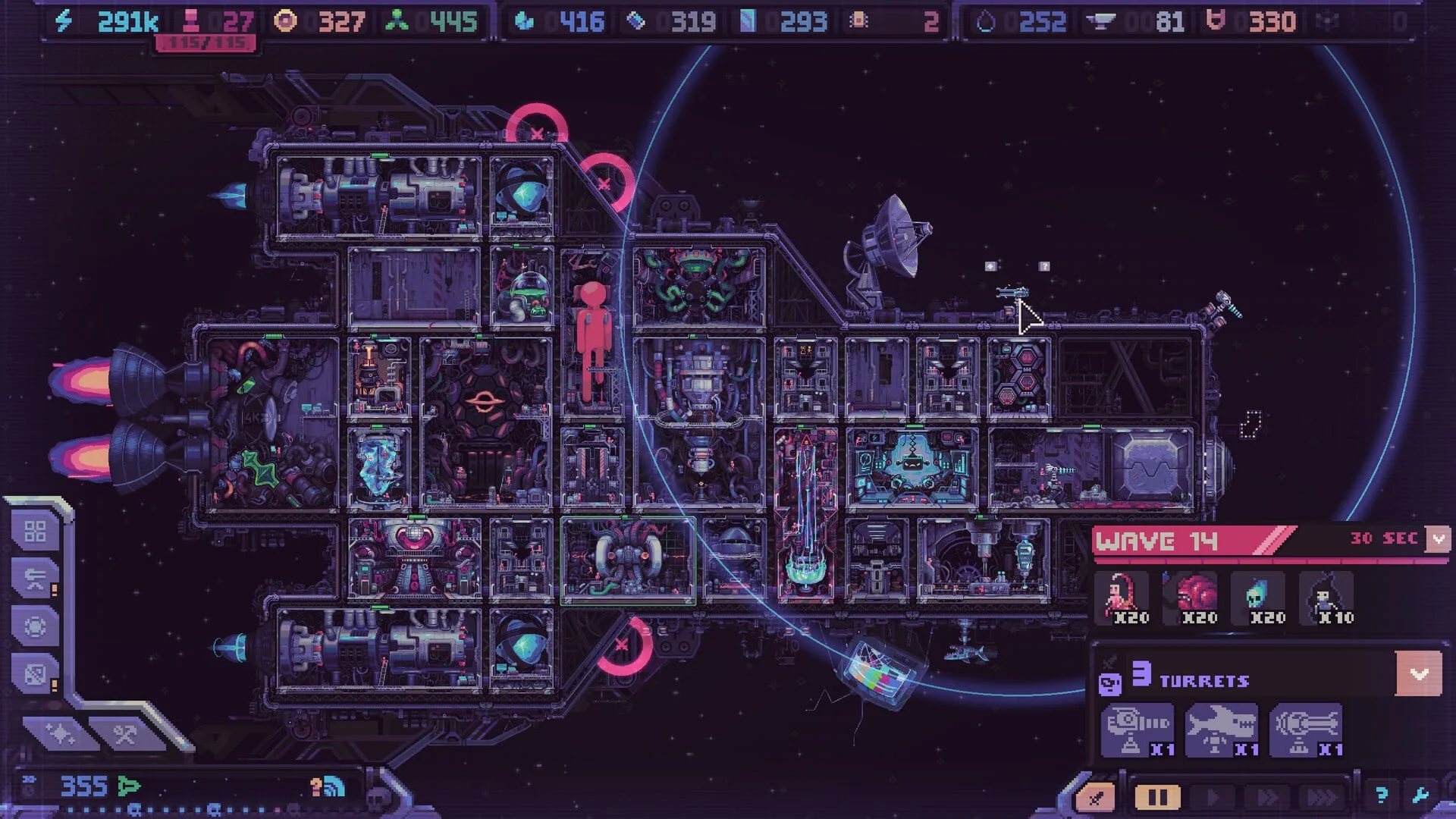
Modules are the rooms inside the hull. Some produce resources, some convert humans into other resources, and some support the ship. The Despot’s Chamber is special: it improves adjacent modules and produces free random module kits when staffed. Adjacency bonuses and artifacts reward compact layouts, while long winding routes reward defensive depth. Those two goals often pull in opposite directions.
Mass, engines and momentum
Every module increases ship mass. More mass means slower travel unless you add engines, and engines burn fuel. A large factory that cannot reach the next shop is not an economy; it is a slower way to lose. The galaxy map guide covers the engine-versus-mass tradeoff in detail.
Economy and production
Hull Rupture uses a chain of resources rather than a single gold pile. Energy powers construction and modules. Humans are workforce, converter input and emergency defenders. Tokens buy shop boxes. Fuel keeps the engines running. Advanced resources such as microchips, nanobots, plasteel and adamantium unlock higher-tier buildings and defenses.
The most common economy failure is not a lack of one resource; it is a missing input or worker upstream. A Microchip Gen. with no minerals and no staff looks identical to a module that does nothing. Use Info Mode to read current per-minute income, then inspect the supply chain behind the number. The production guide gives a diagnosis order.
| System | Question to ask | Fix |
|---|---|---|
| Energy | Is anything unpowered or stalled? | Add generator capacity or reduce demand. |
| Workforce | Are modules staffed and is storage full? | Reproducer, Human Storage, reassign workers. |
| Inputs | Which converter is waiting on another resource? | Fix upstream production before adding downstream modules. |
| Mass | Is travel time eating your route plan? | Engines, Weight Distorter, or stop expanding. |
Defense and waves
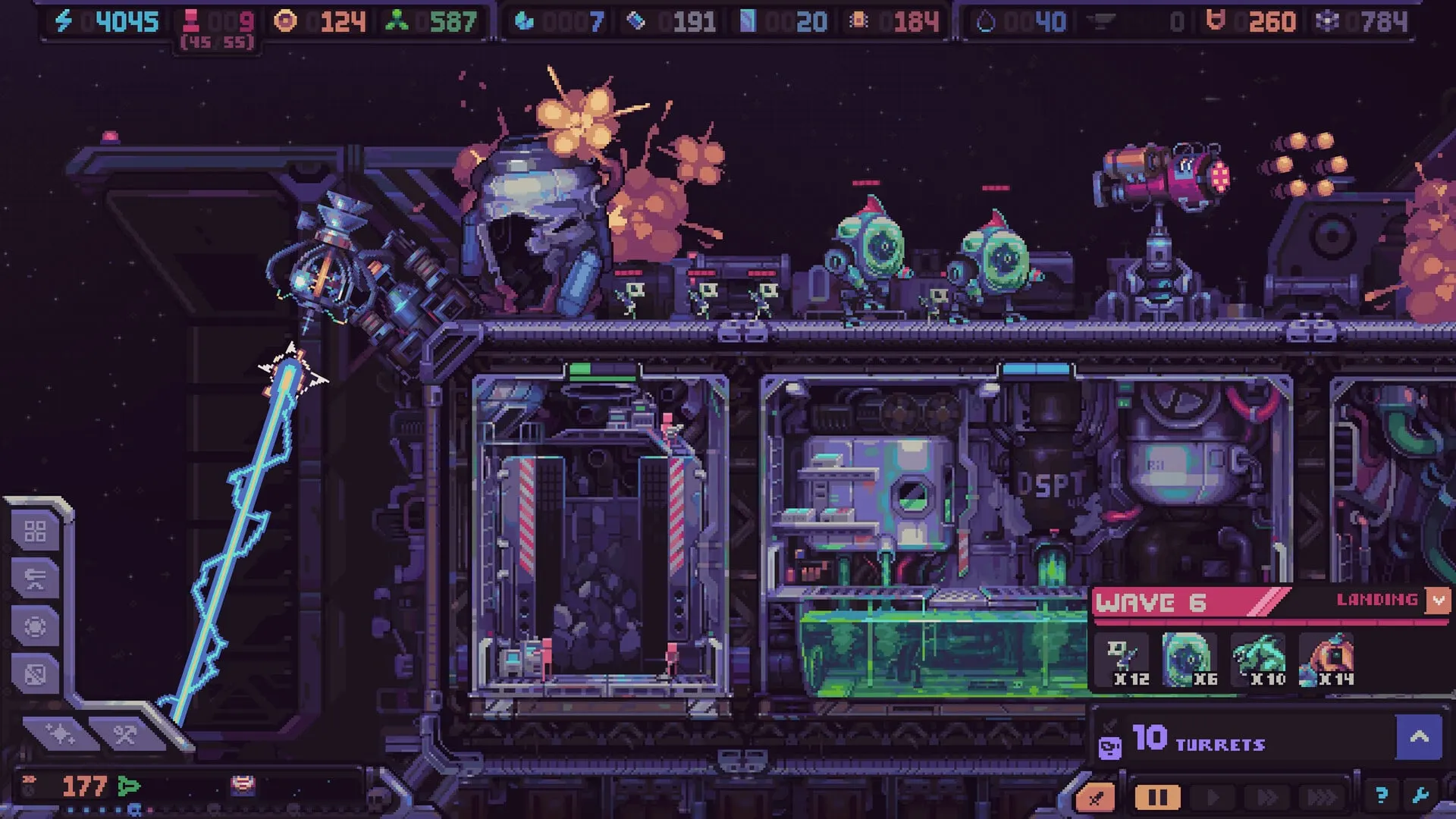
Aliens announce the wave, then land in drop pods across most of the ship’s outer surface. They run along the hull and through internal corridors toward the Airlock. Turrets occupy dedicated slots along those routes. Because you know when and roughly where they will arrive, defense is a planning problem, not a reaction test.
Three layers matter: routing (hull shape), damage (turret type and placement) and control (traps, barricades, slows and debuffs). The Airlock and its crew units are the last layer, not the main plan. After the September rebalance, turrets are explicitly the primary defense and units are the safety net.
Read the turret and defense guide for kill-zone patterns, or browse the turret database for roles and placement notes.
Exploration and events
The galaxy map is not a linear path to a final boss. It is a web of roughly 15 star types, partially hidden by fog of war. Some stars are shops, some are shipyards, some trigger narrative events, and some are guarded locations that throw extra waves at you on higher difficulties. Modifiers earned from events and shops come from largely separate pools, which makes route choice a build decision.
Events can demand resources, humans or a risky choice. Some options only appear if your ship state qualifies. The galaxy map and events guide explains how to value a detour.
Ships and modes
Hull Rupture advertises three ships, six modes and four difficulty levels. Only one ship, the Izumo, has been publicly detailed: a small, maneuverable hull built from salvaged parts, suited to a low-mass, high-speed route plan. The demo includes Classic and Trade modes; the April preview also named Conquest, Cursed, Uneventful, Pure and Impossible.
Endless mode is confirmed as a separate mode at release rather than a continuation of Classic. The final six-mode lineup has not been fully documented, so we avoid presenting a definitive list as fact. See the ships and modes guide for what each known mode changes.
Confirmed vs unannounced
Trust matters more than completeness. This is the line between what is publicly confirmed and what is still unknown as of October 30, 2026.
Confirmed
- Release date: November 4, 2026 on Steam
- Windows, macOS and Linux builds
- 20 waves and a final boss in Classic
- 15 hull block shapes, no rotation
- Themed module and turret boxes
- Izumo as the demo ship
Not announced
- Price and pre-order bonuses
- Names of the other two ships
- Exact final mode lineup
- Console and mobile versions
- Recommended PC specs
- Steam Deck Verified status
Full wiki index
Guides
- Hull Rupture Beginner Guide: Your First Run — A complete first-run plan: what to build, when to expand, how much defense is enough, and the five mistakes that end runs before wave 10.
- Hull Rupture Tips & Tricks: 15 Rules That Matter — Fifteen high-impact habits, from reading current income to moving a turret instead of demolishing it. Small decisions, dramatically better runs.
- Hull Rupture Hull Construction Guide — How the 15-block construction system works, where to attach each shape, and how to build routes that buy your turrets more time.
- Hull Rupture Production & Resources Guide — A practical economy guide: diagnose a stalled line, balance workers and power, and decide when a new module actually helps.
- Hull Rupture Turrets & Defense Guide — Design layered kill zones, match turret range to hull geometry, and make the Airlock a last line rather than your first plan.
- Hull Rupture Galaxy Map & Events Guide — Every jump is a build decision. Learn how star types, events, modifiers and ship mass change the value of a route.
- Hull Rupture Ships & Modes Explained — The Izumo, six announced modes and four difficulty levels: what each one changes, and which is the right starting point.
- Hull Rupture Shop & Module Kits Guide — Themed boxes, Chamber production and kit randomization: how to buy for your next problem instead of a fantasy build order.
- Hull Rupture Demo Guide: What to Play First — The free demo is the best tutorial available. Here is what it includes, how to unlock its value, and what carries into launch.
Database
- Hull Rupture Modules: Production & Support — Every module seen in official material, grouped by production, conversion, logistics, support and propulsion — with placement notes.
- Hull Rupture Resources Explained — What each resource is for, where it comes from, and which shortages deserve an immediate fix versus a route adjustment.
- Hull Rupture Turrets & Defenses — Turret archetypes, defensive modules and airlock units, plus where each belongs on a hull plan.
- Hull Rupture Ships: Izumo & Beyond — What the confirmed Izumo does, how ship identity shapes a run, and the questions to ask when the other two hulls unlock.
- Hull Rupture Enemies & Bosses — Drop pods, boarding routes, boss spawns and the defensive counters that matter when every wave grows stronger.
- Hull Rupture Artifacts & Modifiers — Artifacts change the rules; modifiers change a module. Learn how both pools work and when a single roll is worth restructuring for.
Game information
- Hull Rupture release date — the November 4, 2026 schedule and what is still unconfirmed.
- Hull Rupture demo — contents, modes, length and how to prepare for launch.
- System requirements — PC, Mac and Linux minimums.
- Platforms — Steam, Steam Deck, console and mobile status.
- Update history — official devlogs and demo patches in order.
- FAQ — short answers to the questions readers ask most.
Demo mechanics can change
The game releases November 4, 2026. Values, module availability and balance may change at launch. The guide will be updated against the release build; treat demo-specific numbers as provisional.